- Traditional, Parent-Hosted Wording
- Modern, Couple-Hosted Wording
- Casual and Playful Wording
- Wording for Divorced or Blended Family Situations
- Wording When Both Sets of Parents Are Co-Hosting
- Destination Wedding Wording
- What to Leave Off the Main Invitation
- Wording for Same-Sex Couples
- RSVP Card Wording
- Save-the-Date Wording, for Comparison
- Proofreading Before You Order
- Matching Wording to Overall Formality
- Getting a Second Set of Eyes Before Ordering
- Font and Layout Considerations Alongside Wording
- Ordering Extra Invitations
- A Final Formatting Pass
- Trusting Simplicity
- One Last Thing
- FAQ
Wedding invitation wording sounds like it should be simple until you're staring at a blank template trying to figure out whose names go where, how formal to sound, and what to do if your family situation doesn't fit the traditional template. Here are real examples across different styles and hosting situations.
Traditional, Parent-Hosted Wording
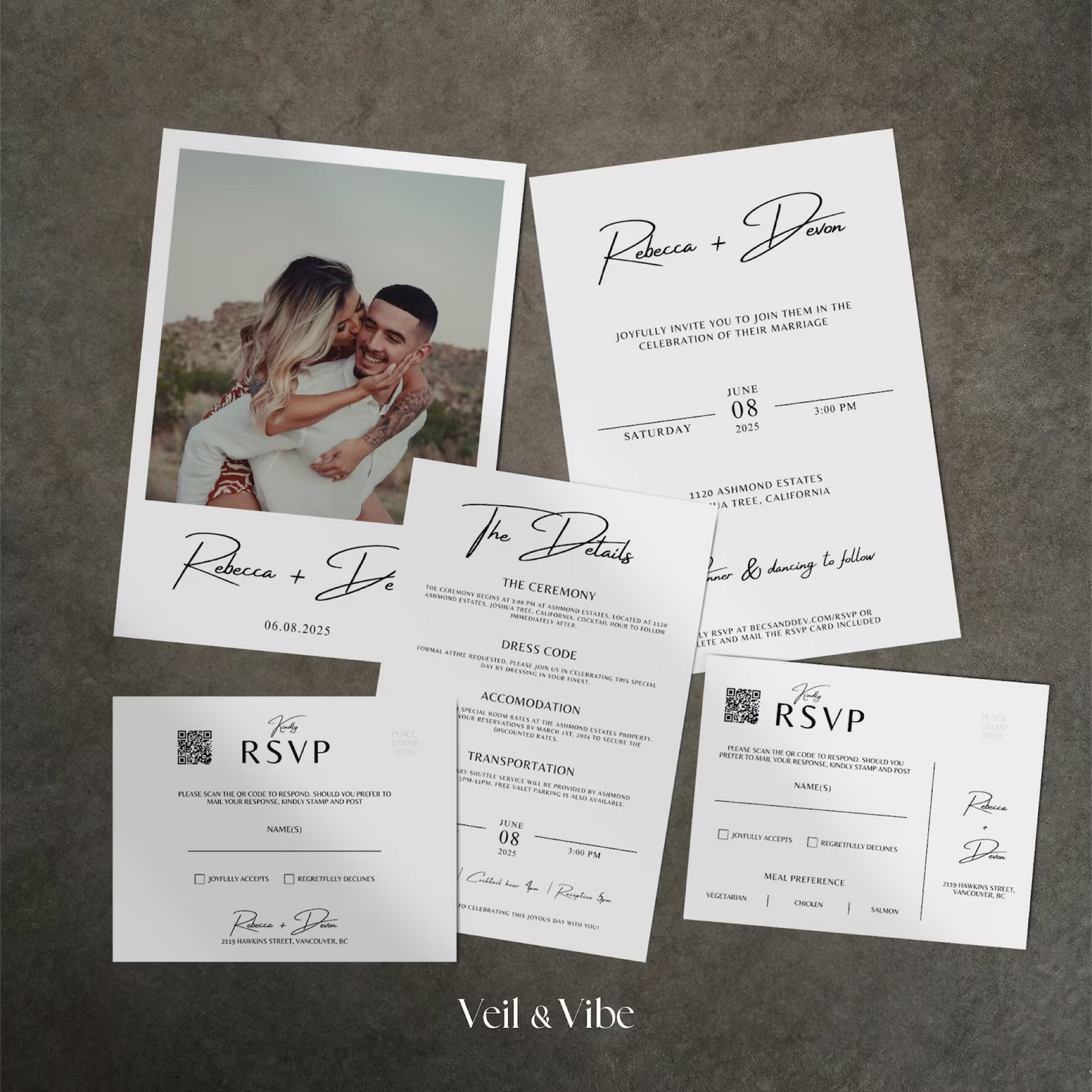
"Mr. and Mrs. [Parent Names] request the honor of your presence at the marriage of their daughter [Bride Name] to [Groom Name], Saturday, the [date] of [month], two thousand twenty-six, at [time], [venue name], [city]." This format explicitly names hosting parents and uses traditional phrasing like "request the honor of your presence," typically reserved for ceremonies held in a house of worship.
Modern, Couple-Hosted Wording
"[Name] and [Name] invite you to celebrate their wedding, Saturday, [date], at [time], [venue name], [city]. Reception to follow." This drops parent-hosting language entirely and centers the couple, which fits most self-funded, modern weddings regardless of ceremony formality.
Casual and Playful Wording
"We're tying the knot! Join [Name] and [Name] as we say 'I do,' Saturday, [date], [venue name]. Let's celebrate!" This style works well for relaxed, informal weddings, backyard celebrations, casual venues, where overly formal language would feel mismatched with the actual event.
Wording for Divorced or Blended Family Situations
There's no single correct format here, clarity and respect for the actual family situation matter more than following a rigid template. One approach: lead with the couple's names as hosts, then include a smaller acknowledgment line, "children of [Parent Name] and [Parent Name]," without implying parents share a household if they don't. Avoid listing a stepparent as a biological parent or omitting a parent entirely unless that reflects the couple's actual wishes.
Wording When Both Sets of Parents Are Co-Hosting
"Together with their parents, [Name] and [Name] invite you to celebrate their marriage." This acknowledges both families as hosts without the more elaborate traditional structure, a common middle ground between fully traditional and fully modern wording.
Destination Wedding Wording
Destination invitations often include additional logistics directly, since guests need more advance information: "Join us as we say 'I do' in [location]! [Name] and [Name] invite you to celebrate our wedding, [date], [venue]. Travel and accommodation details at [website]." Sending these earlier than a standard invitation, ideally 3 months or more ahead, gives guests real time to plan travel.
What to Leave Off the Main Invitation
Registry information, detailed RSVP instructions, and extensive logistics generally belong on the wedding website rather than the invitation itself. Keep the physical invitation focused on the core information, who, what, when, where, and direct guests to the website for everything else. This keeps the invitation itself clean and avoids it feeling cluttered or overly transactional. If you're saving invitation design ideas and wording examples as you research, WedThread sorts them automatically into a Stationery category, so comparing fonts and phrasing across a dozen saved examples doesn't mean scrolling through old Pinterest likes.
Wording for Same-Sex Couples
Traditional invitation templates often assume a bride and groom structure, which doesn't fit every couple. Simplify by leading with both names directly, "[Name] and [Name] invite you to celebrate their wedding," which works cleanly regardless of gender and sidesteps any awkward retrofitting of gendered traditional language. This approach also tends to read as more modern regardless of a couple's gender, so plenty of opposite-sex couples choose it too, simply because it centers the couple rather than leaning on older conventions.
RSVP Card Wording
If you're including a physical RSVP card rather than directing guests to an online form, keep the wording simple: "Kindly respond by [date]," a line for the guest's name, and a checkbox or line for meal selection if applicable. Avoid overly formal RSVP language that can confuse guests about how or where to actually respond, clarity matters more here than elegance, since a confusing RSVP card directly translates into a messier headcount for your caterer.
Save-the-Date Wording, for Comparison
Save-the-dates are typically shorter and less formal than the invitation itself, often just names, the date, and a note that a formal invitation will follow: "Save the date! [Name] and [Name] are getting married [month, year] in [city]. Formal invitation to follow." Keeping this brief and saving the full details for the actual invitation avoids repeating information twice and gives guests just enough to start planning around.
Proofreading Before You Order
Once wording is finalized, proofread carefully, names, dates, venue address, more than once, and ideally by someone other than the person who wrote it. Invitation wording errors are expensive and slow to fix once printed, and a fresh set of eyes catches mistakes the original writer has read past too many times to notice.
Matching Wording to Overall Formality
Whatever wording style you choose, make sure it matches the wedding's actual formality level. Highly formal wording paired with a casual backyard wedding can confuse guests about dress code and expectations, and the reverse is also true. Reading your draft wording out loud and asking whether it matches the mental picture of your actual wedding day is a useful gut check before finalizing.
Getting a Second Set of Eyes Before Ordering
Beyond a straightforward proofread, ask someone unfamiliar with the details, not just close family who already knows everything, to read the wording fresh. They're more likely to catch a confusing sentence or missing piece of information that anyone too close to the planning might read past without noticing.
Font and Layout Considerations Alongside Wording
Wording and design work together more than couples expect. A long, formal wording block needs a layout with enough breathing room to stay legible, while short, casual wording can support a bolder, more graphic design approach. If you're working with a stationer or designer, share your finalized wording early so they can build the layout around it, rather than trying to fit long-winded wording into a design that was built for something shorter.
Ordering Extra Invitations
Order more invitations than your exact guest count, roughly 10 to 15 percent extra, to account for last-minute additions, mistakes during addressing, and keepsakes for yourselves and close family. Reordering a small batch later, if a print run has already wrapped, is often more expensive and slower than simply ordering a few extra in the first place.
A Final Formatting Pass
Once the wording itself is locked in, double-check consistent formatting across every line, capitalization style, how numbers and dates are written out, spacing around the couple's names. Small inconsistencies are easy to miss when you've read the wording dozens of times but stand out clearly to a fresh set of eyes once printed.
Trusting Simplicity
When in doubt, simpler wording almost always ages better than something overly elaborate. Clear, warm, and correct beats clever every time, and it's the version you'll be glad you chose when you look back at the invitation years later.
One Last Thing
However you word it, the invitation's real job is simple: tell guests when, where, and how to celebrate with you. Everything else is just style on top of that.
Something like: 'Mr. and Mrs. [Parent Names] request the honor of your presence at the marriage of their daughter [Name] to [Partner Name].' This formal structure names hosting parents and uses traditional phrasing throughout.
Simplify to something like: '[Name] and [Name] invite you to celebrate their wedding.' This skips parent hosting language entirely and centers the couple, which fits most modern, self-funded weddings.
List each parent by name without implying a joint household unless that's accurate, or simply lead with the couple's names and mention parents separately in a smaller acknowledgment line if desired. There's no single correct format, just clarity and respect for the actual family situation.
Both names, the date, time, ceremony location, and typically a note to check the wedding website for additional details like reception info and RSVP. Keep the core invitation focused, and let the website carry the finer logistics.
Generally yes. Formal wording paired with a casual backyard wedding, or overly casual wording for a black-tie affair, can send mixed signals to guests about how to dress and what to expect.
6 to 8 weeks before the wedding for most weddings, 3 months or more for a destination wedding where guests need extra travel planning time.